Enterprises have invested heavily in AI over the past two years. Copilot licenses, generative AI pilots, prompt-based assistants embedded in every tool. The promise was clear: faster work, fewer errors, measurable productivity gains.
The results have been underwhelming.
Recent MIT (Massachusetts Institute of Technology) research confirms what many IT leaders already suspect: productivity gains from prompt-based AI are modest, inconsistent, and difficult to scale. The reason is structural. These tools require a human in the loop at every step. Ask a question, get an answer, validate the answer, ask another question. The AI assists, but the human still does the work. For ad-hoc tasks – drafting an email, summarizing a document – this is useful. For complex, high-volume business processes, it changes almost nothing.
The problem is not AI. The problem is how we are using it.
From Prompting to Orchestrating
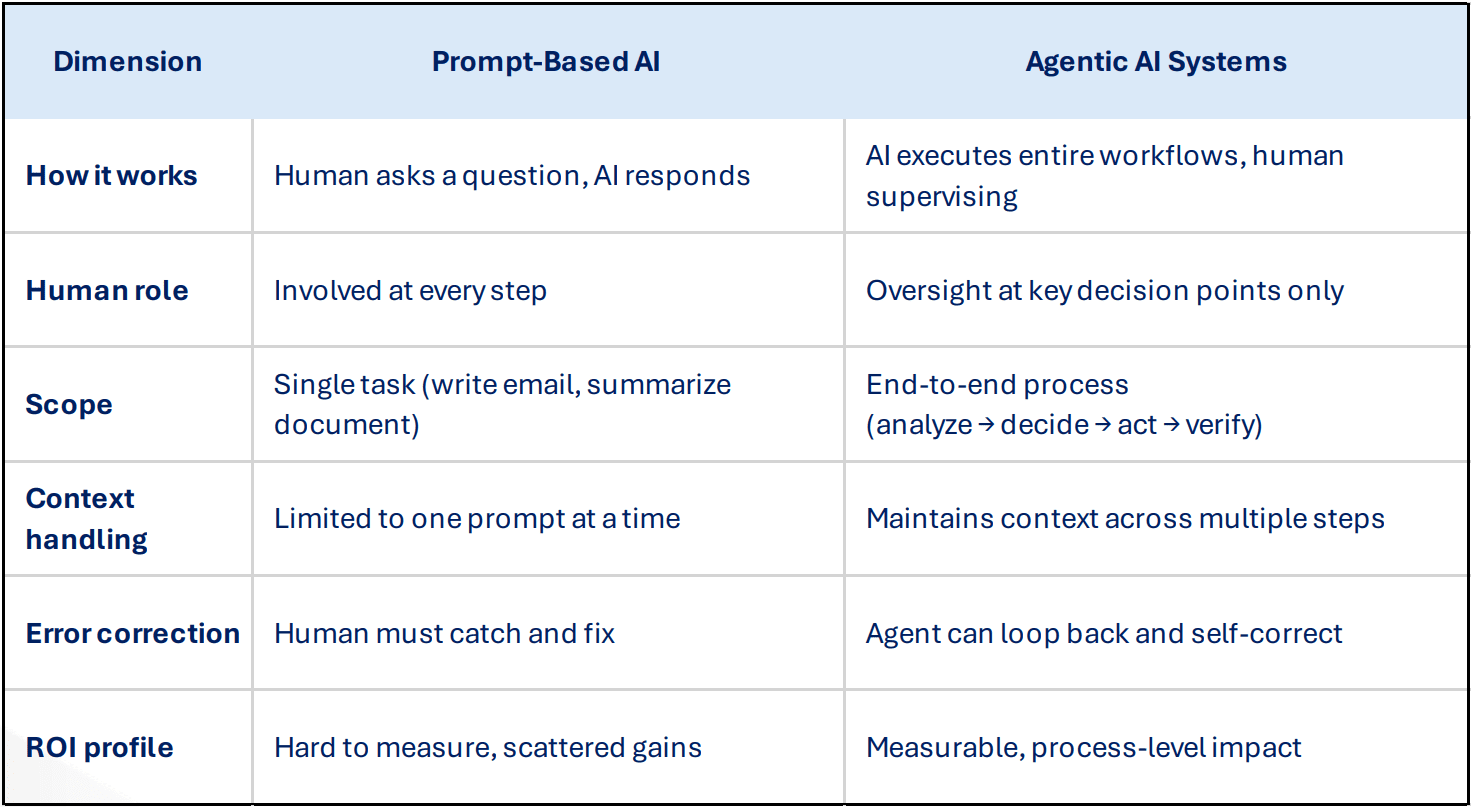
There is a fundamental difference between prompt-based AI and agentic AI systems. Understanding this difference is critical for any enterprise evaluating where to invest next.
Prompt-based AI Prompt-based AI operates on a simple loop: human asks, AI responds, human validates, repeat. The human remains the orchestrator. The AI is a tool – useful, but passive.
Agentic AI Agentic AI operates differently. An agent is given a goal, not a question. It breaks the goal into steps, executes those steps autonomously, calls other tools or agents as needed, evaluates its own output, and loops back to correct errors – all without requiring human intervention at every stage. Humans remain in control, but only at key decision points. The AI becomes a worker, not just an assistant.
This distinction matters in CCM because it determines what can actually be automated.
Why This Matters for CCM
The CCM industry conversation around AI in customer communications has focused primarily on prompt-based capabilities: generative content, smart suggestions, chat interfaces integrated into existing products. These features deliver value for specific tasks. However, they represent an evolution of current approaches, not a transformation of how work gets done. The deeper opportunity lies elsewhere.
Customer Communication Management is a domain defined by volume, complexity, and compliance. Enterprises produce millions of documents – statements, policies, notices, correspondence – across multiple channels, brands, regulatory regimes, and languages. The operational burden is enormous. So is the cost of errors.
This is precisely the environment where agentic AI delivers significant operational impact. The workflows are repetitive but complex. The rules are well-defined but numerous. The exceptions are frequent but follow patterns. These conditions favor autonomous agents operating within guardrails.
Consider the potential applications:
Template migration and modernization
Enterprises often manage thousands of legacy templates accumulated over decades. An agentic system can analyze these templates, identify redundancies, extract business logic, and propose consolidated modern equivalents – work that would take human teams months or years.
Automated quality assurance
Before any communication goes to production, an agent can validate compliance, brand consistency, data accuracy, and regulatory requirements. Not sampling – every document, every time, with full traceability.
Customer journey analysis and optimization
An agent monitors omnichannel delivery performance – open rates, response rates, channel preferences—and identifies underperforming segments or steps. A more advanced agent can automatically adjust workflows to improve engagement, within defined guardrails.
Self-service document generation
End customers or internal users describe what they need in plain language. An agent interprets the request, retrieves relevant data, composes the document, and delivers it – without requiring a predefined template for every possible request.
These examples illustrate the direction. The specific implementations will vary by organization, but the pattern is consistent: multi-step, context-aware, autonomous execution with human oversight where it matters.
There is a broader shift underway. Customer Communication Management has traditionally focused on producing and delivering documents – statements, notices, policies. The process is largely outbound and linear. Agentic workflows enable something different: continuous, adaptive interaction across the full customer lifecycle. Communications that respond to customer behavior, journeys that adjust dynamically, service requests that resolve autonomously. This is the transition from Customer Communication Management to Customer Interaction Management – from documents to dialogue, from delivery to engagement. Agentic AI is the architecture that makes this transition practical.
Why Compart, Why Now
Compart is embracing this shift by focusing on agentic workflows. This is not a marketing label – it is a technical architecture decision with real implications. It means designing systems where AI agents can execute complete processes, integrate with existing platforms, validate their own output, and escalate only when necessary.
This is where the disruption will come. Not from AI that answers questions, but from AI that does work.
We are building this capability in active collaboration with customers and partners. Not theory–working systems, tested against real-world complexity.
The organizations that move early will gain structural advantages: lower operational costs, faster migrations, higher throughput, better customer experience. The organizations that wait will find themselves competing against that new cost structure.
Learn More
See our agentic solutions in action at Comparting 2026, March 12-13 in Sindelfingen, Germany. Join industry specialists to explore how AI agents are transforming omnichannel customer communication workflows. Register at www.compart.com/en/comparting2026
How Agentic AI is Rewriting the Rules of Customer Interactions. Thorsten Meudt, Compart CEO, shares a straight, no-hype view on where the industry stands, what is actually changing, and where it is all heading. Where AI sits in CCM today. What is real, what is useful, and what is still peripheral.
Accelerate your move to a modern CCM system: Migrate large volumes of PDF templates with precision – fully automated and seamless using the DocBridge® Communication Suite.
Compart demonstrates how Artificial Intelligence (AI) is transforming Customer Communications Management (CCM). Learn how AI automates repetitive tasks, optimizes document processes, and simplifies integrations.