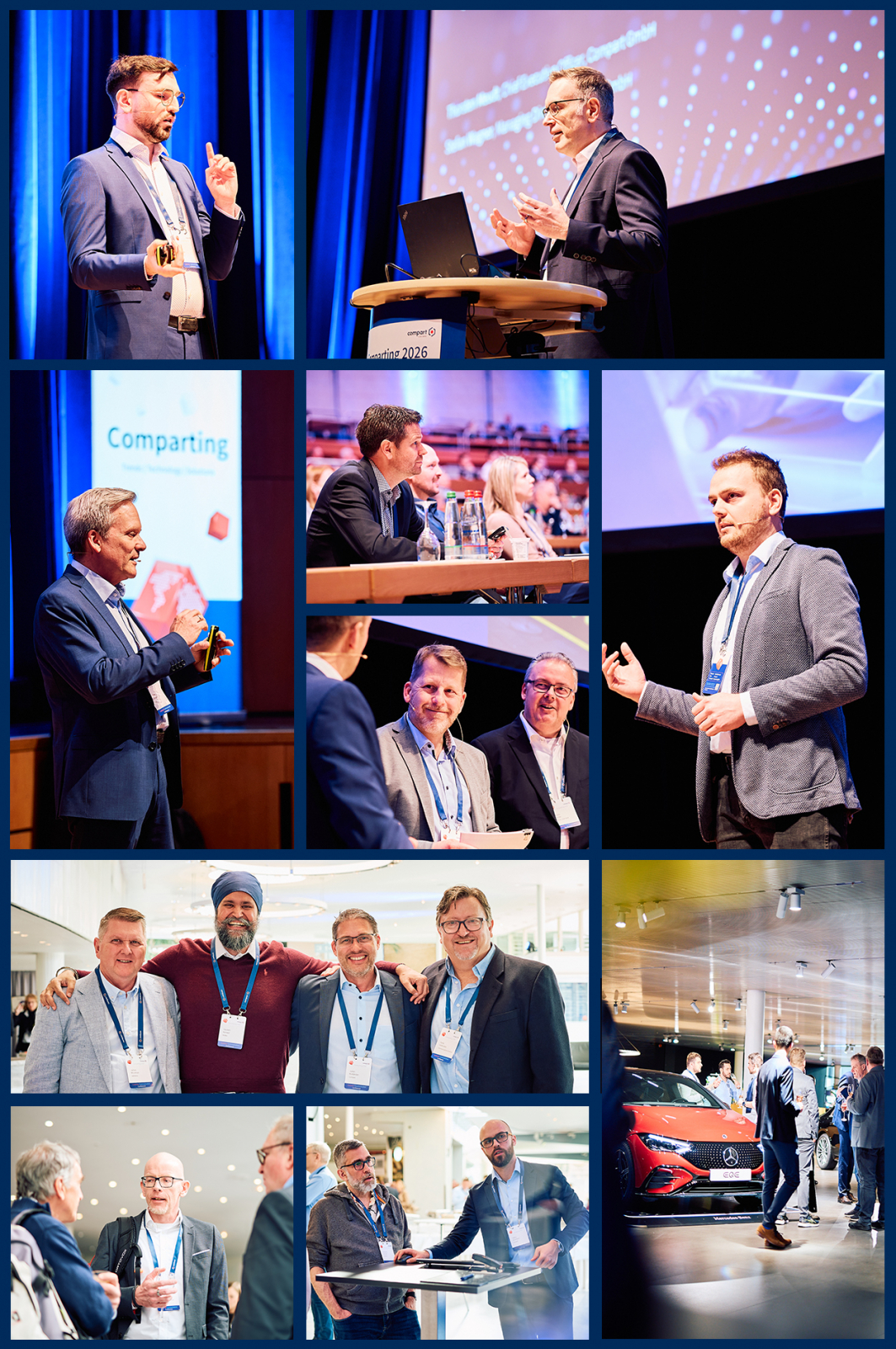
Returning from Comparting 2026, held last week at Stadthalle Sindelfingen in Germany under the theme “The Expert Forum for Omni-channel Communication”, I have been thinking about a distinction that matters more than most of the AI headlines now flooding the market.
There is a difference between adding AI to a business and AI forcing a business to disrupt itself to remain at the center of gravity. That is a topic central to TreelinePress’s view of the market.
At this year’s event, Compart did not strike me as a company merely layering AI onto an aging CCM narrative. It felt more like a company using AI as a lever to move further upstream in the value chain, while still drawing on the engineering strength that made it relevant in the first place.
Starting out building print drivers for OS/2, Compart has spent more than three decades building deep expertise in conversion, workflow, output management, and the infrastructure layer that sits between legacy systems and modern communications environments.
For years, composition has sat at the heart of CCM. But Compart has long operated in the part of the stack that many outside the category barely notice: the hard technical middle, where formats, data streams, workflows, archives, and downstream outputs all have to work reliably at enterprise scale.
Real disruption does not always begin with a flashy newcomer. Sometimes it begins when an established company realizes the center of gravity is moving and decides to move with it before the rest of the market fully understands what is happening.
This is what impresses me most about Compart and its vision of the future. It is unapologetic about its legacy and equally clear about where it is going, even if that direction could eventually undo parts of 30 years of innovation.
"There was a quiet confidence throughout the event. No panic could be detected. That was both reassuring and admirable, especially for a company still relatively misunderstood across much of the U.S. and CCM market."
Andy Young
AI Was Not a Side Topic
The conference agenda itself offered a clear direction. AI was not positioned as a side session or vague future aspiration. It was embedded directly into discussions around template migration, automated document creation, accessibility, business-user empowerment, workflows, and product direction for 2026 and 2027. That suggests a company working to connect AI to the business in a serious and meaningful way.
In my earlier conversation with Compart CEO Thorsten Meudt, recorded as part of a four-part video podcast series, that broader direction became more explicit. He described the company’s initial AI work in practical terms: translation, tone optimization, accessibility support, template generation, and template migration. He also drew an important distinction between assistive AI and agentic AI. Assistive AI keeps the human in the loop throughout. Agentic AI can take action, orchestrate workflows, and bring the human back in only when necessary.
Most of the CCM industry is still comfortable talking about AI as assistive technology. That is the safer story. It improves efficiency. It helps write or translate content. It speeds up design tasks. It lowers the cost of migration. All of that is real. Meudt described practical examples where average-complexity template migration can be reduced from days to minutes.
But assistive AI does not fundamentally change the role of the platform, whereas agentic AI can and likely will, although what that ultimately looks like and how it is managed in a secure and complaint way is still under review.
Why Open Standards Matter More Than Ever
Compart may have an immediate head start in AI not simply because it is investing in exploration of the technology, but because of choices it made earlier around open standards. In our conversation, Meudt spoke directly about the lessons learned from proprietary formats versus open, well-documented, standardized formats, and said Compart took those lessons seriously. He then connected that history to the present AI moment.
The issue is straightforward. Off-the-shelf language models do not naturally understand proprietary CCM formats and platforms. When vendors or customers are trapped inside closed, legacy template structures, they often face a much higher barrier to meaningful AI adoption. They may need to train or fine-tune their own models, which is expensive, technically complex, and operationally difficult. Meudt described this as a real limitation for the industry.
Because the company committed early to open standards, and because its template format is essentially HTML-based, it was able to experiment with mainstream language models much earlier and with far less friction. Rather than having to build and train proprietary models from scratch, Compart could use off-the-shelf models and layer retrieval-augmented generation on top. That is not a cosmetic, it is strategic leverage. It reduces the translation gap which accelerates migration and generation use cases, and allows AI to work much closer to the native language of the system itself.
Legacy expertise can provide strength, but only when it has been built in ways that remain legible to the next wave of technology. That may be one of Compart’s real differentiators now: a framework open enough for AI to work with, rather than something AI first has to decode.
In a market full of vendors trying to retrofit AI into architectures shaped by older proprietary assumptions, this may turn out to be one of Compart’s more immediate advantages. In a characteristically German, disciplined, and understated way, that came through clearly.
A Small Signal That Also Matters
The day before Comparting, a hackathon organized by my friend and industry colleague Didier Rouillard of DNOW! helped set the tone. Hackathons may no longer hold the sway they once did in tech and startup circles, but in this instance, it was an important distinction. In an industry where many companies still prefer to offer polite lip service to AI while quietly protecting the status quo, a hackathon hosted by Compart suggests a willingness to experiment in public, invite new thinking, and engage directly with the uncertainty that real disruption brings. In fact, Thorsten opened the event by highlighting the hackathon in his remarks.
To me, that mattered because it reinforced the broader impression Compart gave throughout the event. This did not feel like fear dressed up as innovation language. It felt more like a business willing to test ideas, expose itself to change, and build forward from its existing strengths.
There may also be a broader ownership lesson here. Compart has been part of GENII since 2022, and company materials have explicitly framed that ownership as strengthening Compart’s position for future development and continuity. In many markets, private equity ownership is assumed to narrow strategic ambition or prioritize short-term optimization. The feeling coming out of Comparting was different. It suggested a company that still has room to invest, experiment, and reposition itself for the next phase of the market rather than simply defend the last one.
From Output Management to Contextual Execution
In my interview, Meudt described Compart’s AI evolution as part of a broader movement into business flows, workflow orchestration, and more autonomous forms of communication handling. In that framing, the platform is no longer just formatting output at the end of a process. It begins to participate earlier, pulling context from other enterprise systems, shaping actions, and potentially driving communication processes more directly.
It moves CCM away from being understood primarily as an end-stage composition and delivery function and toward something closer to a contextual execution layer. In that model, the platform does not simply produce documents after upstream systems decide what should happen. It helps interpret intent, orchestrate actions, and in some cases automate communications themselves. That places CCM much closer to the fuzzy boundary where traditional communications platforms and martech systems begin to overlap.
For years, much of the customer communications industry has operated as if the document were the natural center of the system and, in the U.S. at least, the printed document. Data flows in and a document gets produced. The document is output, delivered, stored, and treated as the durable artifact of record. Even when the channel changes, the operating assumption stays largely the same.
But those assumptions around documents, inputs and outputs, the content of record, and the role of archiving information are all being questioned.
The more AI becomes embedded into enterprise workflows, the less stable the document looks as the primary interface. The document still matters, especially in regulated markets. It still serves as evidence, declaration, notice, explanation and item of record. But it increasingly starts to look like an intermediate artifact rather than the beginning and end of the experience.
The Map Is No Longer the Experience
In one of the more fascinating sessions at this years Comparting, Michael Adamitzki, Head of Document Services at ITERGO Informationstechnologie GmbH, shared his thoughts on “Digital Enrichment,” pushing the conversation in a similar direction. He used the contrast between paper maps and digital navigation as a way to frame what modern communications may become: less about delivering a static representation and more about bringing the right information, context, and action path together in real time. His framing touched directly on real-time information, integration, simplification, augmented experiences, and the challenge of archiving and governing richer digital interactions.
The shift underway is not simply paper versus digital. It is not even document versus non-document. It is static output versus enriched, adaptive, contextual experiences. The map is no longer the experience. The navigation layer is, and this has major implications for legacy CCM.
If communications platforms are moving into a world where information must be dynamically assembled, “like a conveyor belt of data,” as Thorsten put it, then interpreted, delivered, and in some cases acted upon within broader workflows, the winners will not be defined solely by composition strength. They will be defined by how well they connect content, context, systems, orchestration, and compliance.
What Made Comparting 2026 Matter
That is why this biannual event felt important to me beyond the normal industry conference cycle.
There was a seriousness to the discussion that stood apart from the generic AI buzz that is nearly impossible to escape these days. Not every company speaking about AI is rethinking its architecture, economics, or role in the stack. Some are still using the language of innovation to protect old positions. Some are trying to preserve the center of gravity where it has always been.
"Compart, at least from what I saw and heard, seems more willing to accept that gravity is moving, which is not an easy task for legacy companies."
Legacy can become a trap. It can encourage businesses to defend the categories, workflows, and commercial assumptions that made them successful in the past. But legacy can also be an asset when it contains deep operational knowledge, hard-won technical discipline, and a realistic understanding of enterprise complexity.
That is what makes Compart worth watching right now.
Not because it has abandoned its history, but because it appears to understand that history only remains valuable if it can be used as leverage for the next transition.
Impressions form the event – watch the video: