How Compart Is Removing the Oldest Friction in CCM
The market has done this before
Around 2002-2004, the CCM market went through a generational transition. Until then, building customer communications meant scripting: code written by specialists, in proprietary environments. Then a small number of vendors introduced visual, WYSIWYG, low-code composition, and the market reorganized itself around them. One or two players made that transition early, captured the opportunity, and defined the market structure that lasted twenty years. Those who stayed with scripting did not disappear overnight. They amortised a declining model, project after project, until the question was no longer whether to move, but how much the delay had cost.
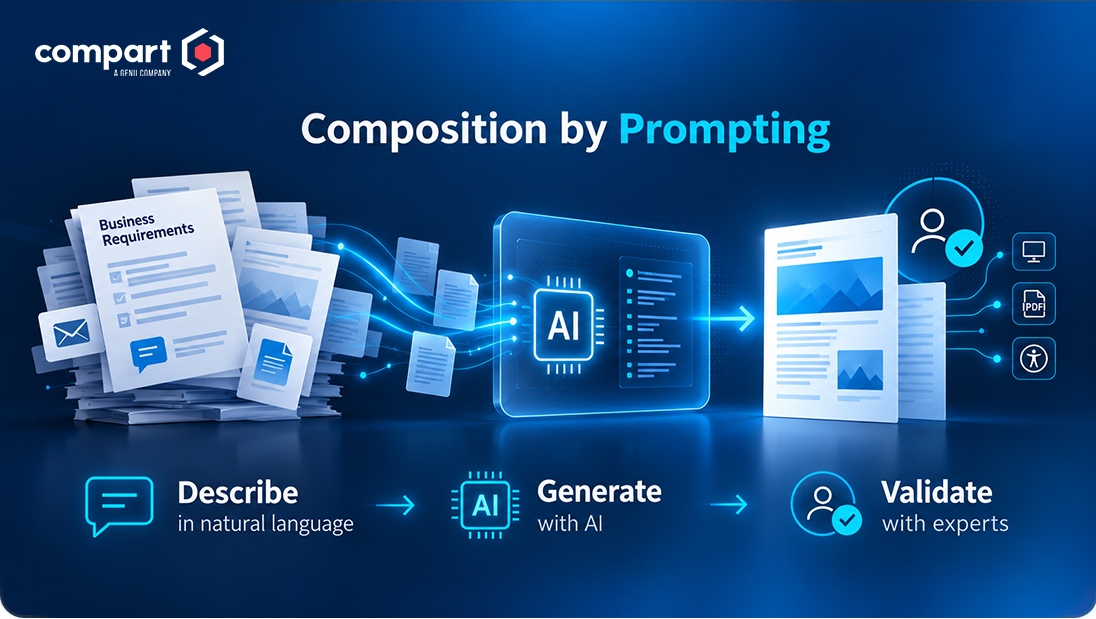
Composition by Prompting is the same kind of transition, one level up. What WYSIWYG was to scripting, prompting is to low-code: the interface between human intent and platform execution moves up another level of abstraction, from code, to visual design, to natural language. It builds on low-code rather than replacing it: the visual and low-code layer remains the foundation, while prompting becomes the faster and more intuitive way to drive it.
The same market dynamic applies. The players who make this transition early will be well positioned to shape the next twenty years of CCM. Continuing to invest in a legacy model based on WYSIWYG design may well resemble the choice made by those who kept investing in scripting in 2004.
The cost nobody considers
The hidden cost of traditional CCM composition
- Business requirements
- Design and composition
- Buiness user authoring
- Execution production
- Omnichannel delivery
Every CCM professional knows this translation chain: A business requirement document is written by a line of business. The CCM team reads it, interprets it, asks for clarifications, and rewrites it as specifications. The specifications are then translated into templates, business rules and data structures using a proprietary design interface, by people with rare skills within the organization. Tests follow, then production.
Most of the friction lives within the early stages: between what the business meant and what the platform was told to do.
The market has learned to live with it because the traditional low-code CCM model is built on these constraints: scarce skills, proprietary languages, layered validation cycles. The cost is invisible in any budget line. It is dissolved into lead times, backlogs and a bottleneck concentrated on a handful of experts.