


A cross-country solution for your eInvoicing
Factur-X • FatturaPA • Facturae • XRechnung • … • ZUGFeRD
Factur-X • FatturaPA • Facturae • XRechnung • … • ZUGFeRD
Across the European Union, more and more countries are making electronic invoices mandatory – each with its own formats, deadlines, and delivery channels. Non-EU companies are affected too, as soon as they have a subsidiary or branch in one of these EU countries: the local mandate applies there, regardless of where the parent company is headquartered.
Building a new, separate solution for every country puts you at a disadvantage. At its core, this isn't a format problem – it's an architecture question: how do you decouple source systems, country requirements, validation, and delivery so the solution stays maintainable five years from now?
Compart takes a different approach: new country and format requirements are connected centrally – without having to rebuild your invoice creation process every time.
eInvoice
An eInvoice is an invoice issued, transmitted, and processed automatically in a structured, machine-readable format. A PDF file sent by email generally does not qualify as an eInvoice under current regulations. Formats such as XRechnung, ZUGFeRD, or Factur-X – based on the European standard EN 16931 – are required. Outside Europe, each country has its own regulatory requirements, formats, and delivery channels.
A global trend
The following examples show what this means in practice – from laws already in effect to deadlines just around the corner:
Germany – Receiving
All B2B companies must be able to receive eInvoices.
Germany – Issuing
Phased in by company revenue, mandatory for all B2B companies by 2028 at the latest.
France
B2B: receiving applies to all companies. Issuing is phased: large/mid-sized companies from Sept 1, 2026, SMEs/micro-businesses from Sept 1, 2027.
Other countries worldwide
More European countries are developing their own requirements – and eInvoicing mandates are steadily increasing outside Europe too.
As of: August 2026. For a legally sound assessment of your specific countries, we recommend consulting your legal department. Further country-specific information is available in the White Paper.
Strategic significance
For international companies, eInvoice is not a footnote for the IT department – it's a strategic decision that affects Finance, IT, Procurement, and customer communication.
Missing or faulty eInvoices mean delays, follow-up queries, and, in the worst case, tax disadvantages.
Without a clean architecture, every country and format becomes a new standalone project.
ERP, billing, and specialist systems deliver data in completely different structures.
Requirements will keep changing – today's architecture has to withstand that.
Our architecture principle
Understand semantics. Validate invoices. Generate formats. Control output.
Invoice creation, validation, PDF generation, format conversion, and delivery need to work together seamlessly – often across multiple countries, departments, and existing ERP or customer communication processes. This is exactly where our architecture principle comes in.
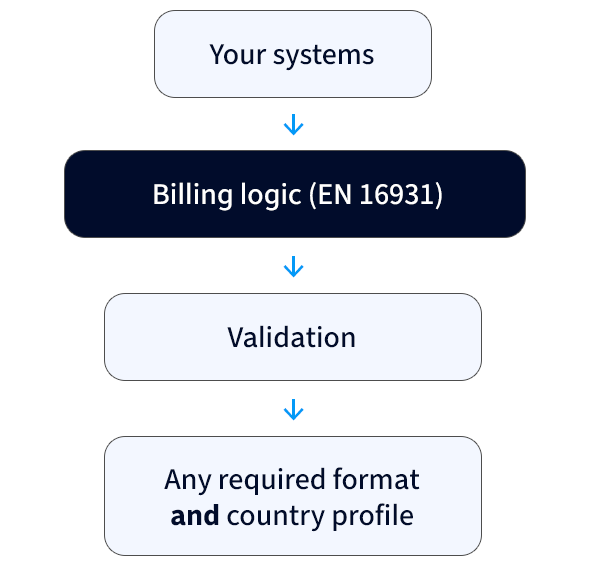
An invoice number stays an invoice number – no matter which technical format it's ultimately transmitted in. That's why Compart first standardizes invoice information at the business level and maps it to a semantic model based on the European standard EN 16931. Only then are the required formats and profiles generated.
The effect: your internal systems don't need to know every eInvoice format in detail. New countries, formats, and regulatory requirements can be integrated without reworking invoice creation each time.
IT and architecture leads can find the technical details in the White Paper.
Get the White Paper hereMany eInvoicing projects stop at pure format conversion. Compart goes further: the semantics of electronic invoices are connected with the power of modern CCM and output processes – invoice information is understood at the business level once, validated centrally, and made available flexibly for different formats and outputs. With a semantic architecture based on EN 16931, you're prepared for upcoming regulatory changes – compliant today, and ready to connect tomorrow.
This is playing out very concretely right now: EN 16931-1:2026, adopted in spring 2026, fundamentally revises the underlying semantic data model – with new business rules, new fields, and adjusted validation. Factur-X or Facturae remain in place as formats but are being adapted to the new, non-backward-compatible syntax. As the new requirements are rolled out step by step, migrating to the updated standard becomes increasingly relevant for affected companies. At Compart, such a change is tracked centrally in the semantic model – once, in one place – rather than separately in every individual country- and format-specific transformation.
What makes the difference
Many eInvoicing providers stop at a valid XML file or handover to a network. Compart takes the story further: structured invoice data, PDF, hybrid invoice, document processing, quality assurance, and output process. For you, that means one point of contact and one solution – instead of multiple tools and interfaces.
For us, eInvoicing doesn't end at XML.
The central processing core is the business invoice model based on EN 16931 – not UBL, CII, or a proprietary target format. For you, that means adding new formats or countries without rebuilding your existing invoice logic.
We process the meaning of an invoice – not just its format.
Source data is interpreted at the business level once. Different eInvoice and output processes are generated from the same semantic invoice logic. That means less effort per country and faster rollout of new requirements.
One invoice logic. Different formats and outputs.
Widely used KoSIT validation checks at the syntax level (UBL/CII) and stops at the first structural error – you work through errors one by one, without knowing how many more are coming. We validate on the semantic model, independent of syntax, and show all errors at a glance.
All errors at once, instead of step by step.
EN 16931, CIUS, and profile-specific requirements are conceptually separate from the processing logic. For you, that means new legal requirements can be rolled in without interrupting running processes.
Integrate new requirements without rebuilding the invoicing process.
Mapping, validation, format generation, and hybrid invoicing can be used individually. For you, that means investing only in what you actually need – not being forced into a complete package.
Use exactly the function your process is missing.
Your benefit
The DocBridge® Communication Suite eInvoice Hub decouples business-level invoice creation from technical and country-specific eInvoice requirements.
In day-to-day operation, that means:

Without fundamentally rebuilding invoice creation.
Iour ERP and billing systems don't need to know individual eInvoice formats – format adjustments happen centrally in the Hub instead of being spread across every source system.
Semantic validation detects all errors in a single pass and describes them clearly – instead of working through them step by step.
Structured, hybrid, or visual – accessible on request, all from the same controlled process.
Integrates into existing DocBridge Communication Suite processing chains and combines with existing CCM and output processes.
The architecture stays clear and maintainable even after years – not just for the next requirement, but for every future one.
Let's talk about your specific situation
In this consultation, we'll clarify what your eInvoicing mandate means for your existing system landscape – and how quickly you can become compliant.
Download our free White Paper “eInvoicing in Europe” instead – with a regulatory overview and architecture approach to read at your own pace.
An e-invoice is an invoice issued in a structured, machine-readable electronic format that enables automated electronic processing. In Germany, since 2025, a simple PDF without structured invoice data no longer qualifies as an e-invoice. Examples of suitable formats include XRechnung and ZUGFeRD.
In Germany, since January 1, 2025, a simple PDF no longer qualifies as an eInvoice because it does not contain structured invoice data for automated processing. Hybrid formats such as ZUGFeRD, however, combine a human-readable PDF with structured invoice data and can meet the requirements for an e-invoice.
eInvoices must generally use a structured electronic format that enables automated processing. In Germany, XRechnung and ZUGFeRD version 2.0.1 or later in particular meet these requirements. Other agreed structured formats may also be permitted if the invoice data required by law can be extracted correctly and completely and converted into a format that complies with or is interoperable with EN 16931.
Automatisierte Prüfung und Verarbeitung senken Fehlerquote und Durchlaufzeit. Laut Billentis-Studie sparen Unternehmen dadurch 60–80 % der Kosten gegenüber Papierprozessen.
XRechnung is a fully structured, XML-based invoice format that complies with the EN 16931 series of standards. ZUGFeRD, by contrast, is a hybrid format that combines structured XML invoice data with a human-readable PDF file. ZUGFeRD version 2.0.1 or later also meets the requirements for an e-invoice in Germany.
EN 16931 is the European standard defining the semantic data model for the core elements of an electronic invoice. It defines the information and business rules required to make structured eInvoices interoperable and suitable for automated processing and provides the basis for numerous national eInvoicing standards and profiles.
Since September 1, 2026, all businesses in France must be able to receive electronic invoices. Large companies and intermediate-sized enterprises (ETIs) must also issue electronic invoices from this date. The obligation to issue electronic invoices applies to SMEs and micro-enterprises from September 1, 2027.
Not necessarily. A centralized eInvoicing solution can decouple invoice creation in the ERP system from country-specific formats, validation rules, and transmission channels. This means ERP and billing systems do not have to support every target format themselves. Depending on the existing system landscape, however, interfaces or data provisioning may need to be adapted.
eInvoices enable invoice data to be validated, processed, and posted largely automatically. This can help businesses reduce manual data entry, errors, processing times, and process costs. Automated e-invoicing can deliver significant cost savings compared with paper-based invoice processes. A Billentis report estimates potential savings of 60–80% for electronic and automated invoice processes compared with traditional paper-based processing.
New country and format requirements are connected centrally, without rebuilding your existing invoice creation process – so you implement new requirements faster instead of starting a new standalone project for every country.
There is currently no nationwide eInvoicing mandate in the US or Canada themselves. However, US and Canadian companies are affected as soon as they have subsidiaries or branches in countries with their own eInvoicing mandate, such as Germany, France, or other EU states – the respective local mandate applies there, regardless of where the parent company is headquartered.
EN 16931
A CEN-compliant European standard for the semantic data model of an electronic invoice – the shared business foundation for all national formats. This standard, established by the European Committee for Standardization (CEN), ensures both technical and legal interoperability, simplifying cross-border business transactions.
XRechnung
Germany's purely structured XML format based on UBL syntax, used for the mandatory eInvoice.
ZUGFeRD / Factur-X
EN 16931-compliant hybrid formats that embed structured invoice data within a PDF document – human-readable and machine-processable at the same time.
Peppol BIS Billing 3.0
An international exchange profile for eInvoices.
CIUS
Core Invoice Usage Specification – a country- or application-specific variant of EN 16931 that defines what is mandatory, optional, or restricted. In Germany, the national CIUS is the XRechnung standard. Conformance with the CEN standard enables EU-wide processing.
